
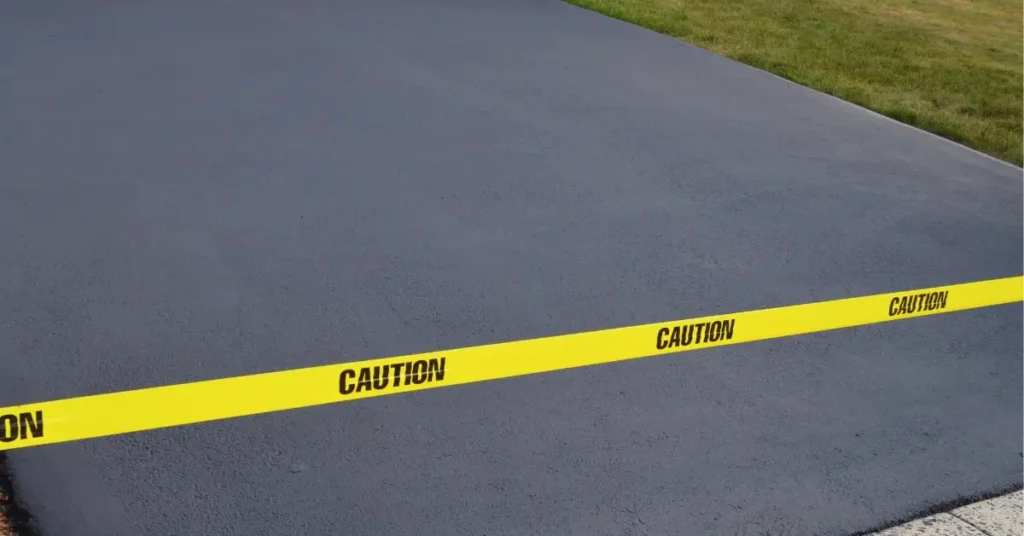
Your new driveway goes down on a Tuesday. By teatime it looks finished: jet black, smooth, cool under your hand. The car is parked out on the road, the kids are eyeing it up for their bikes, and the obvious question is whether you can just pull in.
Not yet. If you’re asking how long does tarmac take to dry, the honest answer is that it depends on what you mean by “dry.” You can usually walk on new tarmac after 24 hours and drive a normal car on it after about three days. But it won’t be fully hard for six to twelve months, and how you treat it in that window decides how it looks for the next twenty years.
Here’s what’s actually happening under the surface, and how to get through the first few weeks without leaving a permanent tyre scar by the front door.
Tarmac doesn’t really dry. It cools, then hardens
“Dry” is a slightly misleading word here. Tarmac isn’t a wet material like paint or concrete. On most UK driveways it’s crushed stone bound together with bitumen, a thick, sticky binder. It arrives hot, at somewhere around 140 to 160°C, and gets rolled flat while it’s still soft.
So there’s no water to evaporate. What you’re actually waiting for is two separate things:
- Setting. The bitumen cools and stiffens enough to hold its shape under weight. This is the tarmac setting time most people have in mind, and it takes hours to a few days.
- Curing. Over the following months, the lighter oils in the bitumen slowly oxidise and the whole surface hardens. It’s also why fresh tarmac starts out glossy black and mellows to a softer charcoal grey over the first year.
If you’ve had concrete laid before, don’t use that as your guide. Concrete cures through a chemical reaction with water and follows completely different rules.
When can you drive on new tarmac? A realistic timeline
This is roughly how the first year breaks down for a standard domestic driveway:
| Time after laying | What’s fine | Hold off on |
|---|---|---|
| First 24 hours | Nothing, keep it clear | Walking, pets, bikes, wheelie bins |
| 24 to 48 hours | Careful walking in flat shoes | Cars, heels, anything on a stand |
| 3 to 5 days | Driving a normal car in and out slowly | Turning the wheel while parked, heavy vans |
| 2 to 4 weeks | Everyday use | Skips, caravans, motorhomes, jacks on bare tarmac |
| 6 to 12 months | Fully cured | Normal care only |
Every installer gives slightly different advice, and they know the mix and depth they’ve just put down, so follow what yours tells you. When we lay tarmac driveways, our advice sits in this range, and we give you the exact wait on the day based on the weather and the job.
The three-day mark for cars is the one people push hardest against. It’s understandable when you’re parking on a busy street or carrying shopping half a road away. But one extra day costs you nothing, and a gouge in fresh tarmac is there for good.
Tarmac curing time in the UK: the weather has a say
British weather has a big effect on tarmac curing time. Driveways here go down in conditions ranging from muggy July afternoons to raw February mornings, and the surface behaves differently in each.
Summer is the tricky one. You’d expect heat to speed things up, but it works the other way. Strong sun keeps the surface warm and soft for longer, which makes it easier to mark. A dark drive in full sun can soften noticeably again weeks after it was laid. If a heatwave lands in the first month, vary where you park slightly each day, and ask your installer whether lightly cooling the surface with a hose is worth doing for your mix.
Cooler months firm up faster. In autumn and winter, tarmac stiffens quicker once it’s down. The catch is that it also loses heat faster on the way from the lorry to the ground, so it has to be laid and rolled promptly to compact properly. That part is the installer’s job, not yours, but it’s a good reason to choose a crew that works quickly and tidily.
Rain on the day. A bit of drizzle after rolling usually isn’t a problem. Heavy rain or standing water during laying is, and a decent firm will move the date instead of pushing on regardless.
The first few months: what actually marks new tarmac
Most damage to a new driveway doesn’t come from driving in and out in a straight line. It comes from weight pressing down on a small point, or from twisting.
The usual culprits:
- Turning the wheel while stationary. “Dry steering” grinds the tyre into the soft surface. Let the car roll forward a little as you turn.
- Stands and small feet. Motorbike side-stands, bike kickstands, ladders, garden chair legs and caravan jockey wheels all sink in. Slip a piece of plywood underneath.
- Narrow heels. Stilettos can leave little dents for the first few weeks.
- Fuel and oil. Petrol and diesel dissolve bitumen. Wipe spills up straight away, and refuel the lawnmower on the grass.
- The same parking spot every hot day. In warm spells, this can leave faint tyre impressions.
Light scuffs often blend in as the surface hardens. Deep gouges don’t. If something does go wrong, take a photo and speak to whoever laid it sooner rather than later.
When waiting really isn’t an option
Some households genuinely can’t go three days without the drive. There might be a Blue Badge holder at home, or a work van that has to be off the street every night. Mention it when you get your quote. A good firm can plan around it, for example by laying the drive in two halves, or booking the job just before you’re away for a long weekend.
If being able to use the drive straight away matters more than a sealed, smooth finish, gravel driveways are worth a look. You can drive on them the moment they’re laid. The trade-off is a bit of raking and topping up now and then, and gravel isn’t the easiest surface for pushchairs or wheelchairs.
This question comes up a lot on the longer drives around Altrincham and Hale, where shared access and two or three cars mean everyone wants to know exactly when they can park again. The answer is the same wherever you live: give new tarmac the time it needs at the start, and it’ll repay you for years.
Planning a new tarmac drive or replacing a tired one? Get in touch and we’ll talk you through the timings for your property before any work starts.


