
Garden drainage solutions are the methods used to move surface water and groundwater away from lawns, borders and paved areas so the soil can dry out between showers. Across Greater Manchester, where heavy clay soils and frequent rain are common, a waterlogged lawn is one of the problems we see most often during garden landscaping in Trafford. The right fix depends on why the water is collecting, how much of it there is and where it can safely go.
This guide explains how to find the cause, which simple fixes are worth trying first, and when a French drain, a soakaway or permeable paving is the better answer.
In this guide
- Why does a garden become waterlogged?
- How to drain a wet garden: start with a test
- Simple fixes for mild drainage problems
- French drain garden UK guide
- Garden soakaway: where the water goes
- Permeable paving and correct patio falls
- When to call a drainage professional
Why Does a Garden Become Waterlogged?
A waterlogged garden is one where the soil stays saturated for hours or days after rain because water cannot soak down or run away fast enough. It is rarely caused by rain alone. Most wet gardens have one or more of these underlying problems:
- Clay soil: fine particles pack tightly together and slow water movement through the ground.
- Compaction: foot traffic, building work and machinery squeeze out the air pockets water needs, which is common on new-build plots with thin topsoil.
- Low spots and poor levels: water runs to the lowest point of the garden and stays there.
- Hard surfaces draining onto grass: patios, paths and driveways laid without proper falls push rainwater straight onto the lawn.
- Downpipes discharging onto the ground: a single roof can send a large volume of water into one small area.
- A high water table: in low-lying areas the ground can already be saturated from below.
How to Drain a Wet Garden: Start with a Test
Learning how to drain a wet garden starts with measuring how quickly your soil absorbs water, which shows whether surface fixes will work. A simple percolation test takes a day:
- Dig a hole roughly 30cm wide and 30cm deep in the wettest part of the garden.
- Fill it with water and let it drain completely to pre-soak the surrounding soil.
- Fill it again and time how long it takes to empty.
If the hole empties within a few hours, the problem is most likely surface compaction or poor levels. If water is still standing the next day, the soil itself drains poorly and the water needs to be moved away rather than left to soak in.
During heavy rain, note where water enters and pools, and whether it comes from next door, a patio or a downpipe.
Simple Fixes for Mild Drainage Problems
Mild drainage problems are usually caused by compacted topsoil and can often be improved without digging trenches. These are the measures worth trying first:
- Aerate the lawn: hollow-tine aeration in autumn removes small plugs of soil so air and water can get in. Brush a sandy top dressing into the holes afterwards.
- Improve the soil: work organic matter such as well-rotted compost into borders each year to open up heavy clay. Small amounts of sand mixed into clay can make it set harder, so avoid that approach.
- Raise the planting: raised beds lift roots above the wettest layer of soil.
- Choose suitable plants: moisture-tolerant plants such as ferns, hostas and dogwoods can turn a damp corner into a feature.
- Redirect downpipes: send roof water into a water butt or a planted rain garden instead of onto the lawn.
If the lawn still holds water after a season, a structural solution is needed.
French Drain Garden UK Guide: How It Works
A French drain is a gravel-filled trench containing a perforated pipe that collects groundwater and carries it to a suitable outlet. In a typical French drain garden UK installation, the trench is around 150mm to 300mm wide and 450mm to 600mm deep. It is lined with a geotextile membrane, part-filled with clean gravel, fitted with the pipe, then topped with more gravel before the membrane is folded over and the soil and turf are replaced.
The pipe is laid with a steady fall, commonly around 1 in 100, so water keeps moving towards the outlet. On larger lawns, several branch drains can feed into one main run in a herringbone pattern.
French drains suit the bottom of a slope, a boundary where water arrives from next door, or a long strip of wet lawn. A French drain only moves water, so it must discharge into a soakaway, a ditch or watercourse, or a surface water drain where permission has been given. It should never be connected to a foul sewer.
Garden Soakaway: Where the Water Goes
A garden soakaway is an underground pit, filled with rubble or modern plastic crates, that holds collected water and lets it seep slowly into the surrounding soil. It is the most common outlet for a French drain or a redirected downpipe when there is no ditch nearby.
Building Regulations guidance in England says a soakaway should be at least 5 metres from a building, so it does not undermine foundations. Its size depends on the area draining into it and on how fast the soil absorbs water, which is measured with a proper percolation test. Plastic crates wrapped in geotextile store more water than the same volume of rubble and are easier to install in tight gardens.
On heavy clay that barely drains, a soakaway can fill up and stay full. In that case the water may need to go to a ditch or an approved surface water connection instead.
Permeable Paving and Correct Patio Falls
Permeable paving is a hard surface that lets rain pass through into the ground below instead of running off, and it is one of the most effective ways to stop paved areas flooding a garden. Options include permeable block paving, resin-bound surfaces and gravel.
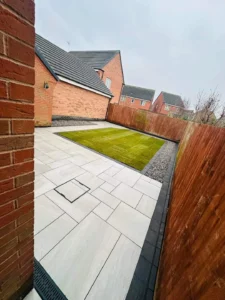
Patios should be laid with a gentle fall away from the house, usually between 1 in 60 and 1 in 80, so water runs into a border, gravel strip or channel drain rather than onto the lawn or against the walls. If water sits on an existing patio or runs straight onto the grass, relaying it with the correct falls during patio installation in Trafford usually solves the problem at its source.
In England, paving over 5 square metres of a front garden with an impermeable surface that drains onto the road needs planning permission. Permeable surfaces do not.
When to Call a Drainage Professional
Professional help is worth considering when water reaches the house, the problem covers most of the garden, or DIY fixes have not worked after a full season. Look out for these signs:
- Water pooling against house walls, air bricks or the damp-proof course.
- A lawn that stays waterlogged for most of the winter.
- Water arriving from neighbouring land or a public path.
- Uncertainty about where the water can legally discharge.
- A new patio, driveway or lawn already being planned, which is the best time to build drainage in.
We offer free site surveys for driveway and landscaping in Urmston and across Trafford, checking levels, soil type and existing drains so the solution matches the cause.
Garden Drainage FAQs
What is the cheapest way to improve garden drainage?
Aerating the lawn, adding organic matter to borders and redirecting downpipes cost very little and fix many mild problems caused by compaction.
Do I need planning permission for a French drain?
A French drain within your own garden does not normally need planning permission. Connecting surface water to a public sewer does need approval from the local water company.
Can you drain a garden on clay soil?
Yes, but clay usually needs a solution that moves water away, such as a French drain running to a ditch, combined with soil improvement. A soakaway on clay should always be tested first.